The Itch You Can’t Ignore: A Mum’s Guide to Surviving Nit Season Without Losing the Plot
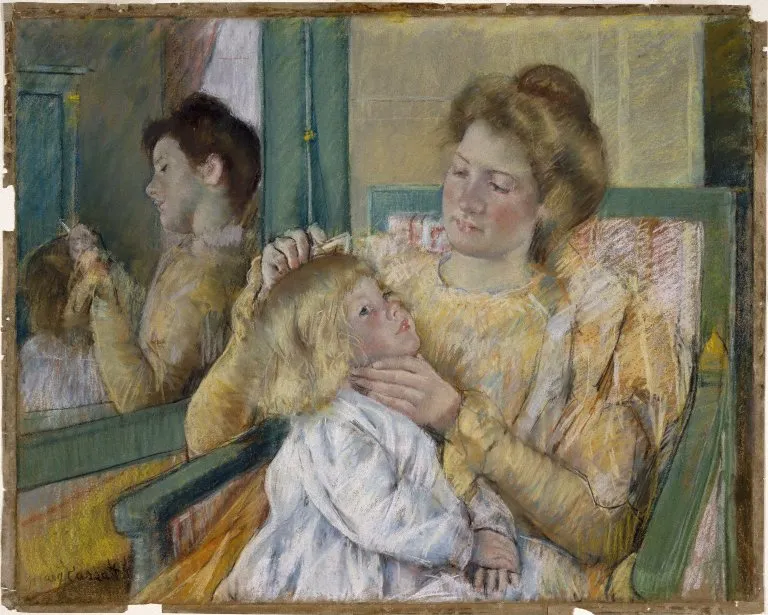
Photo: Mary Cassatt, Public domain, via Wikimedia Commons
There is a particular shade of pale that comes over a mum’s face when she pulls a folded letter from the book bag and reads the words “a case of head lice has been reported in your child’s class”. It is not quite fear. It is not quite fury. It is the look of a woman mentally replaying every hug, every hair-related chat and every soft-play ball pit of the last fortnight, while also wondering whether it is socially acceptable to shave everyone’s head and start again.
Welcome to nit season. The season of hope, conditioner and small plastic combs with teeth like tiny rakes. The season where the school gate develops an collective itch and everyone starts casually inspecting their own scalp in the reflection of a phone screen.
The letter arrives
The letter never arrives on a quiet day. It lands on the morning you are already late, already wearing odd socks and already negotiating with a seven-year-old about why we cannot take a hamster to school for show-and-tell. You read it while balancing a lunchbox on one knee and think: right. This is my life now.
The first instinct is to panic-buy every potion in the pharmacy aisle. The second is to burn the house down and claim on the insurance. The third, and the one worth listening to, is to take a breath and remember that head lice are an equal-opportunity nuisance. They do not care about your cleaning routine, your postcode or whether your child’s hair is brushed or has developed its own ecosystem. They are not a judgement. They are just tiny, wingless commuters looking for a scalp to call home.
First, a word about shame (and why you can bin it)
There is a strange shame that clings to the nit letter, as if a louse has a clipboard and a set of standards. It does not. Head lice are not a sign of poor hygiene. They are not a sign that your house is dirty. They are not a sign that you have failed as a parent. They are a sign that your child has been near another child, which is, unfortunately, the entire point of school.
So let’s agree to park the shame at the door, next to the muddy wellies and the bag of apples nobody eats. You are not the first mum to receive this letter and you will not be the last. In fact, half the class probably got one too. They are just not talking about it, because they are too busy scratching.
The conditioner-and-comb marathon
Once the letter lands, the real work begins. The NHS-approved method is simple in theory and mildly athletic in practice: wet the hair, slather on plenty of conditioner, and comb through section by section with a fine-toothed detection comb. Wipe the comb on a piece of kitchen roll after each pass. Look for live lice — not the empty egg cases, which can cling on like tiny regrets long after the party is over.
This is not a five-minute job. This is a podcast-and-a-biscuit job. This is the job where you discover your child has approximately four million hairs and each one has formed a personal attachment to your comb. You will find a louse on the bathroom tiles and briefly consider moving house. You will find another on the shoulder of your jumper and question every life choice that led you here.
The key is to repeat the wet combing on days one, five, nine and twelve. It is a commitment. It is also far more effective than half-heartedly squirting something on and hoping for the best. Think of it as a mini spa treatment, if the spa was your bathroom and the treatment was an intense scalp audit.
The sibling inspection standoff
There is a moment in every nit outbreak when you must inspect the other children. This is where diplomacy comes in. One child will submit cheerfully, mostly because they are hoping for screen time afterwards. The other will act as if you have asked them to undergo a full body scan by a robot with a clipboard. They will form a union. They will claim they have already been checked. They will point out, with great offence, that their head feels “fine, actually”.
Stay firm. Check everyone in the house, ideally on the same day. Otherwise you will treat one child, congratulate yourself, and then find a louse doing lengths in the other child’s fringe three days later. Head lice do not respect sibling boundaries. They are not loyal. They are tiny opportunists with no sense of family loyalty.
The laundry mountain
Let’s talk about the laundry. The moment nits are confirmed, every parent in Britain becomes convinced that the entire house must be washed at ninety degrees. Bedding, towels, hats, scarves, the teddy bear that has not been washed since 2019. It is a full-scale domestic event.
The good news is that lice do not survive long off the head. They need the warmth and food supply of a human scalp. You do not need to fumigate the sofa or set fire to the dressing-up box. Wash the pillowcases and any recently worn hats if it makes you feel better — it often does — but the main event is the combing. The housework can wait. It usually does.
School-gate scratching and the art of the casual head check
At drop-off, the word “nits” travels faster than a cold. One mum mentions it and suddenly everyone is scratching. It is like yawning. You will find yourself rubbing your own scalp with the casual air of someone who is definitely not worried, while secretly planning to comb your own hair the second you get home.
Try not to point fingers. Try not to whisper about whose child might have brought it in. It could have come from anywhere — a sleepover, a football club, a birthday party, a soft-play centre where the ball pit is basically a louse holiday camp. The only way through is to tell the people who need to know, check your own family and keep the lines of communication open. A quick text to the mum group is far more useful than a silent judging campaign.
What actually works (and what’s a waste of a tenner)
Fine-toothed comb and conditioner: yes. Patience: yes. Repeating the combing on days one, five, nine and twelve: yes. Checking the whole household: absolutely.
Tea tree oil, mayonnaise, vinegar and desperate internet potions: not proven. They may make your bathroom smell like a chip shop, but they will not necessarily solve the problem. If you want to use a treatment product, speak to a pharmacist and follow the instructions properly. And remember: only treat if you find live lice. Empty egg cases are just souvenirs.
The bit where we all calm down
Nits are annoying. They are time-consuming. They turn an ordinary Tuesday into a military operation involving conditioner, kitchen roll and a child who suddenly needs the loo every four minutes. But they are also common, treatable and completely survivable.
So text the school if you find them, check your lot, keep combing and try to laugh. In a few weeks, it will be someone else’s turn to find the letter. And you will be the one at the school gate, scratching casually, offering a sympathetic nod and the loan of a very good comb.